Exacta Bet Minimum Stake UK: Tote Limits and Unit Pricing
 Available in US
Table of Contents
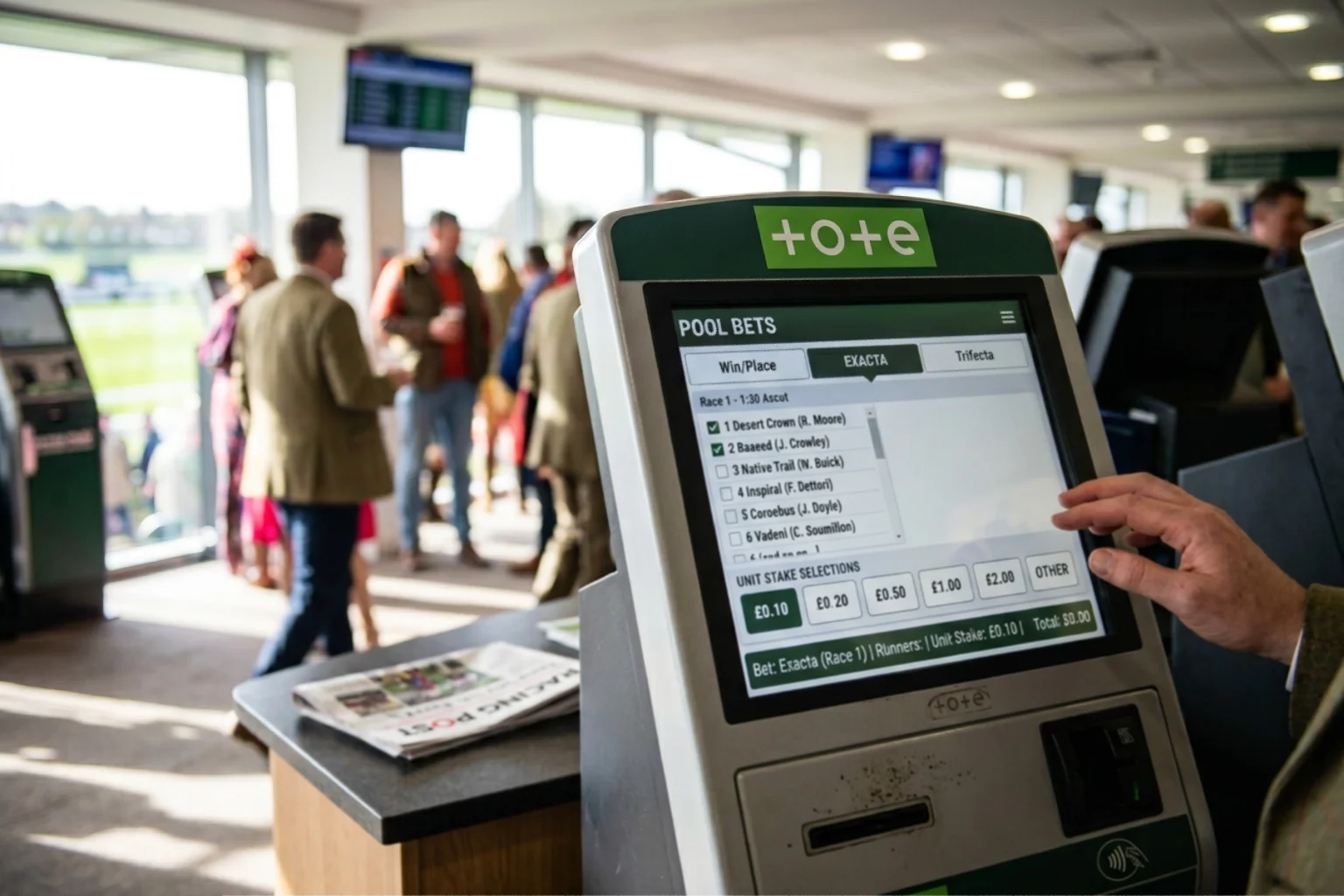
I once watched a first-timer at Newbury fumble through three different screens on the Tote terminal, convinced he needed at least a fiver to place an exacta. He walked away without betting. The irony? He could have placed a perfectly valid exacta for as little as ten pence per combination. That misunderstanding costs punters real opportunities every single raceday, and it is one of the most common questions I field from readers getting started with pool betting. Visit horse racing exacta bet for UK stake information.
The minimum stake for a Tote Exacta in the UK is not a single fixed number – it depends on whether you are betting online or on-course, how many combinations your bet covers, and the unit size you select. Getting this right is the difference between a well-structured bet and either overspending or missing the pool entirely. The Tote deducts 25% from the Exacta pool before calculating dividends, so every penny of your stake matters in terms of cost efficiency.
This guide breaks down the exact figures, explains how unit pricing works, and clarifies the differences between placing your exacta at the racecourse versus through the Tote website. If you have ever hesitated over the minimum spend, this is where that uncertainty ends.
Minimum Stake Rules
A question I get asked at least once a week: “What is the actual minimum for a Tote Exacta?” The answer has a few layers, and the confusion is understandable because the Tote handles minimums differently from a standard bookmaker.
On the Tote website and app, the minimum total stake for an Exacta bet is typically one pound. That does not mean each combination costs a pound – it means your total outlay across all combinations must reach at least that threshold. If you place a straight exacta on a single combination, that one-pound minimum applies to that single line. If you box three horses, your total across the six permutations must hit the minimum.
The unit stake – the amount you wager on each individual combination – can go as low as 10p online. This is where the flexibility lives. A three-horse boxed exacta at 10p per combination costs you 60p in total, but you will need to add an extra combination or increase the unit to meet the one-pound floor on most platforms. At 20p per combination, that same three-horse box costs £1.20, clearing the minimum comfortably.
On-course Tote terminals at racecourses operate with their own rules. The minimum unit at most tracks is £1 per combination, making on-course exacta betting significantly more expensive for multi-combination bets. A four-horse boxed exacta at £1 per combination runs to £12, while the same bet online at 10p per line costs just £1.20. That price gap matters, especially for punters who like to spread their selections across several horses. The pool deduction sits at 25% regardless of where you place the bet, so the only variable within your control is the unit size and number of combinations.
One detail that catches people out: the minimum applies per bet slip, not per race. You cannot split a three-horse box across two separate slips at 30p each and expect both to process. Each submission must independently meet the threshold. I have seen punters try this workaround at Cheltenham – it does not work.
For context, Britbet – the pool operator managing on-course betting at numerous UK tracks – processed £73.6 million in on-course pool turnover during 2024, a 26% increase from 2018. That growing volume reflects wider participation, but the on-course minimums remain higher than online. If you are cost-conscious, the Tote website gives you far more granular control over your exacta spend.
Unit Pricing Explained
I spent my first year of pool betting thinking in whole pounds. It took an experienced Tote punter at Ascot to show me that the real skill in exacta staking lies in the unit structure, not the headline number.
Unit pricing is straightforward once you grasp the principle. Your unit stake is the amount wagered on each individual combination within your exacta bet. The total cost equals the unit stake multiplied by the number of combinations. A straight exacta has one combination. A boxed exacta on N horses has N x (N-1) combinations. A keyed exacta with one banker and four other runners has four or eight combinations depending on direction.
The available unit increments online typically run from 10p upward in 10p steps. Some platforms allow 5p units on certain pool types, but 10p is the standard minimum unit for Tote Exacta bets placed digitally. This means a five-horse box – twenty combinations – costs just £2.00 at the minimum unit. Compare that with the on-course minimum of £1 per combination, and the same five-horse box would set you back £20.00 at the track.
Why does unit sizing matter beyond the obvious cost difference? Because the Tote Exacta dividend is declared to a £1 unit. If you bet at 10p per combination and the declared dividend is £45.60 to a £1 stake, your return on a winning combination is £4.56. The dividend does not change based on your unit size – it scales linearly. Smaller units let you cover more combinations for the same total outlay, which is particularly useful in large-field races where the finishing order is hard to narrow down.
A practical example: you fancy three horses for first and second in a ten-runner handicap. A three-horse box gives you six combinations. At £1 per combination, that is £6 total. At 25p per combination, that is £1.50 total. The £1 version returns four times more on a winner, but the 25p version lets you add a fourth horse for just £1.50 more (twelve combinations at 25p = £3.00 total), covering twice as many outcomes for half the cost of the original three-horse box at full units.
The strategic implication is clear: unit pricing turns the exacta from a high-commitment bet into a flexible, scalable tool. I use lower units almost exclusively for handicaps and reserve full-pound units for short-field races where I have strong conviction on two runners.
Tote Online vs On-Course
Standing in the Tote queue at York last summer, I overheard a couple debating whether the on-course pools and online pools were even the same thing. They are – the money goes into one combined pool. But the experience of placing the bet differs in ways that directly affect your wallet.
Online, through tote.co.uk or the Tote app, you get the lowest unit minimums (10p), the widest range of bet types, and the ability to see indicative pool sizes before committing. You can structure a complex part-wheel exacta at fractional units without queueing or explaining your bet to an operator. The interface shows your total cost before confirmation, eliminating arithmetic errors.
On-course, the experience is more traditional. Tote windows and self-service terminals at racecourses accept pool bets, but the minimum unit is typically £1. Some tracks still operate manual windows where you write your selections on a slip – these can handle bespoke combinations, but the staff may not always be familiar with complex structures like part-wheels. Self-service terminals are more consistent but limited in the bet types they offer.
There is one scenario where on-course betting has an edge: cash handling. If you prefer to bet with cash and avoid linking a bank account or card to an online platform, on-course Tote windows accept notes and coins. This is a personal preference rather than a financial advantage, but it matters to a segment of racegoers who attend meetings specifically for the live experience.
The dividend you receive is identical regardless of channel. A £1 exacta placed on-course pays the same declared dividend as a £1 exacta placed online. The pool is commingled – every pound from every source feeds the same pot. The Tote Exacta UK pool mechanics apply uniformly, so the only practical difference is your entry cost per combination and the ease of structuring your bet.
My recommendation for anyone serious about exacta betting: place your bets online for the cost efficiency and flexibility. Use on-course terminals for simple straight exactas when you are at the track and want the immediacy of a quick bet between races. The pool does not care where your money comes from – but your bankroll will notice the difference between 10p and £1 units over the course of a full raceday card. Once you know the minimum, learn how to place an exacta bet on the Tote.
Can I place an exacta for less than one pound on the Tote?
Yes, online through tote.co.uk or the Tote app you can set unit stakes as low as 10p per combination. However, your total bet amount must typically meet a minimum threshold of one pound per bet slip. A ten-combination exacta at 10p per line would cost one pound and clear that minimum.
Do on-course Tote terminals accept the same minimum as online?
No. On-course Tote terminals and windows generally operate with a minimum unit stake of one pound per combination, significantly higher than the 10p minimum available online. The declared dividends are identical regardless of channel, but on-course multi-combination bets cost considerably more due to the higher per-line minimum.
Written by the editors at Horse Racing Exacta bet.