Exacta Payout Explained: How UK Tote Dividends Are Calculated
 Available in US
Table of Contents
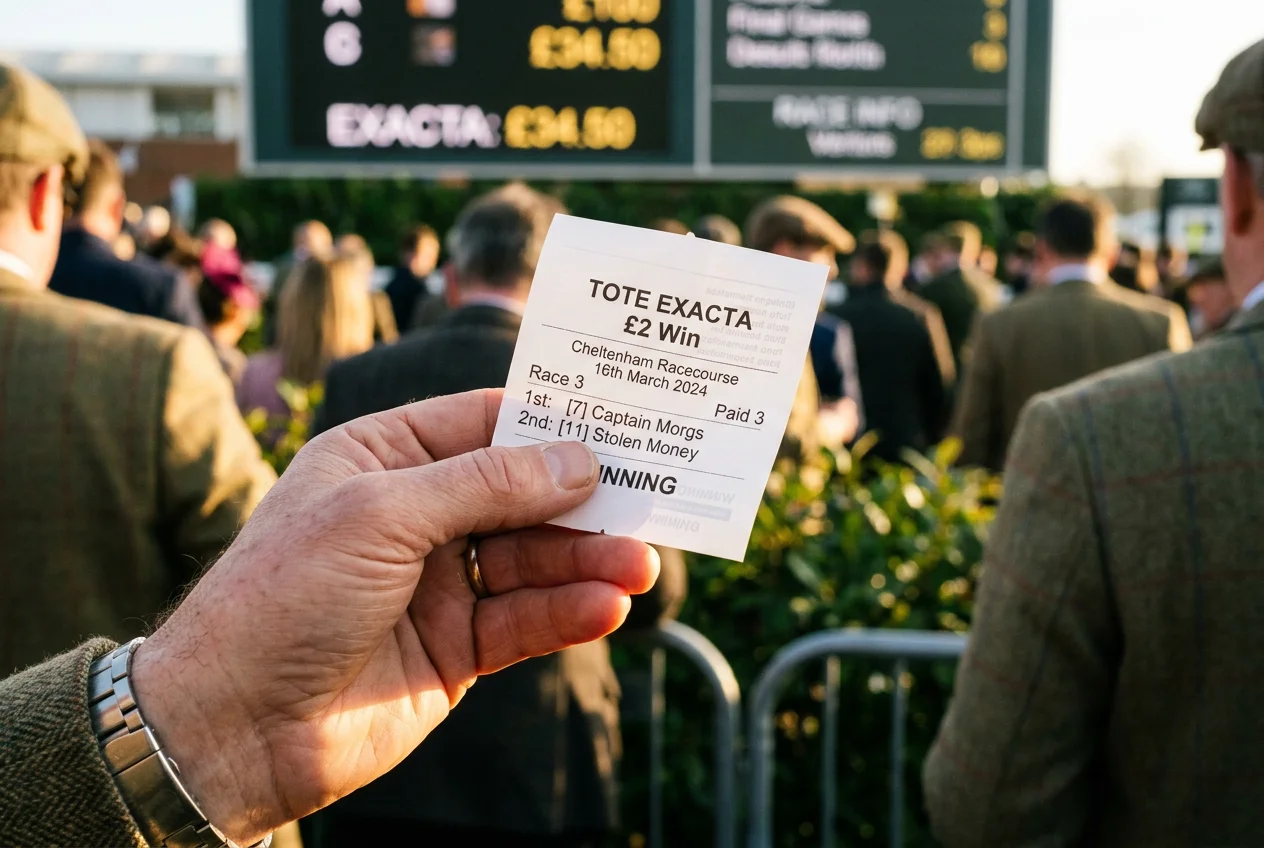
The first exacta dividend I ever collected was 23 pounds 40 pence. I remember the number exactly because I had expected something closer to 80 and spent the next hour trying to understand where the other 56 pounds 60 pence had gone. The answer, I eventually learned, was not theft or a system error – it was the fundamental mechanics of pool dividend calculation, a process that every serious exacta bettor needs to understand before placing a single unit. Visit horse racing exacta bet for all Tote payout guides.
Across a sample of 3,270 turf flat races in the UK, the average Tote Exacta dividend came in at 102 pounds 44 pence per one-pound unit, compared to 61 pounds 50 pence for the Computer Straight Forecast on the same races. That 67% premium tells you the Exacta pool is, on average, a better vehicle for forecast betting than the CSF. But averages hide enormous variation – I have seen dividends as low as two pounds and as high as four figures on the same afternoon card. Understanding why requires getting into the mechanics of how pool money flows from your bet to your payout.
This guide breaks down the dividend formula step by step, examines how deductions affect your returns, walks through real UK examples, and identifies the factors that determine whether your exacta pays handsomely or barely covers the stake.
The Dividend Formula: Maths Behind Every Payout
I once explained pool dividends to a friend using a pub quiz analogy. Everyone pays a pound to enter, the pub keeps a cut, and the rest goes to the winner. The Tote Exacta works on the same principle, just with more runners and a more complicated prize structure.
The formula is: take the total pool, subtract the deduction, then divide the remainder by the number of winning units. The result is the dividend declared to a one-pound unit stake.
Let me walk through it with numbers. Suppose 20,000 pounds is bet into the Exacta pool on a race. The Tote deducts 25%, removing 5,000 pounds. That leaves 15,000 pounds for distribution. Now suppose the winning combination – Horse A first, Horse B second – attracted 150 one-pound units from the betting public. The dividend is 15,000 divided by 150, which equals 100 pounds to a one-pound unit.
If only 50 units backed the winning combination, the same pool pays 300 pounds. If 500 units backed it, the dividend drops to 30 pounds. The total pool and the deduction are fixed once the race goes off; the only variable is how many bettors correctly identified the winning pair and in what amounts.
This is why exacta dividends are so unpredictable compared to fixed-odds betting. A bookmaker forecast price is set before the race – you know what you will receive if you win. A Tote Exacta dividend depends on what everyone else has done, and you do not know the final figure until after the race. The uncertainty is the trade-off for the potential upside: when the result surprises the market, fewer units share the pool, and the dividend spikes.
On World Pool races, the same formula applies but with two differences. The deduction drops to 19.5%, leaving more money in the pool. And the total pool is dramatically larger because it draws from international contributors. Both factors tend to increase dividends on World Pool days relative to standard Tote racing, though the effect varies by race and by how the global betting public has distributed its money.
One detail that catches new bettors off guard: the dividend is declared to a one-pound unit, but your actual return is proportional to your unit stake. If you bet at 50p per unit and the dividend is 100 pounds, you receive 50 pounds. If you bet at 10p per unit, you receive 10 pounds. The dividend figure is a standardised reference point, not a guarantee of absolute return. Always multiply the declared dividend by your unit stake to calculate your actual payout.
How the Deduction Shapes What You Receive
That 25% deduction feels abstract until you see what it means across a season. If you wager a total of 1,000 pounds into Tote Exacta pools over the course of a year, 250 pounds is removed before a single dividend is calculated. You are effectively starting every race 25% behind. To break even, your winning bets must generate dividends that total at least 1,000 pounds on whatever remains of your stake after losses.
The Tote’s average margin across all racing products sits at roughly 6.3%, which is lower than many fixed-odds bookmakers’ overrounds. But the Exacta-specific deduction of 25% is higher than the Win pool (typically around 13.5%) because the complexity and lower turnover of exotic pools require a larger percentage to cover operational costs and return money to the sport. The Tote Guarantee – which tops up online Win and Place bets to match the starting price when the pool dividend falls short – does not apply directly to Exacta dividends. Your Exacta return is the pool dividend, pure and simple.
Comparing the Tote deduction to what you lose in a bookmaker’s margin is not straightforward because the two systems extract their cut differently. A bookmaker embeds margin in the odds: if the true probability of a forecast result is 20/1, the bookmaker might offer 16/1, pocketing the difference. That hidden margin can exceed 40% on complex forecast markets. The Tote takes its 25% transparently and then distributes the rest entirely to winning unit holders. In races where the result is popular (many bettors backed the winning combination), the Tote’s fixed deduction can make it less competitive than the bookmaker. In races where the result is unpopular (few bettors backed it), the Tote dividend can dwarf the bookmaker payout because the pool redistribution mechanism concentrates money among fewer winners.
This dynamic is why the Tote Exacta consistently pays more than the bookmaker forecast on the majority of races. The pool system inherently rewards contrarian results, while bookmakers cap their liability and adjust prices to limit exposure. If you are the type of bettor who looks for value in unexpected finishing orders rather than backing obvious pairs, the Tote’s deduction structure works in your favour despite the headline 25% figure.
Real Dividend Examples From UK Racing
Data tells you what to expect on average. Specific examples tell you what is possible – and what to watch out for.
The Tote reported that in 73% of races on World Pool days in 2025, the Exacta paid more than the equivalent bookmaker forecast, with the Exacta returning on average 30% more. That is not a marginal advantage; it is the kind of systematic edge that compounds over a full season of betting. On a broader dataset, including non-World-Pool racing, the Tote has claimed that the Exacta pays more than the bookmaker forecast in 83% of races – a figure that accounts for both the pool dividend advantage and the generally thinner margins on Tote products.
Consider a typical scenario at a Premier flat meeting. A 12-runner Class 2 handicap with an Exacta pool of 15,000 pounds. After the 25% deduction, 11,250 pounds is available for distribution. The winner goes off at 8/1 and the runner-up at 14/1 – a result that most casual bettors did not have. Perhaps 30 one-pound units backed the correct combination. The dividend: 375 pounds to a one-pound unit. A bettor who placed a two-horse box at one pound per unit spent two pounds and collected 375 pounds on the winning leg. Net profit: 373 pounds on a two-pound outlay.
Now take the opposite scenario. A five-runner Group 1 race where the 4/7 favourite beats the 5/2 second favourite. The Exacta pool might be 25,000 pounds – bigger because it is a high-profile race – but the winning combination is the one most bettors backed. If 800 units hold the correct combination, the dividend after deduction is 23 pounds 44 pence. That same bettor with a two-horse box at one pound per unit collects 23 pounds 44 on a two-pound investment – still profitable, but a world away from the handicap example.
The lesson from these two scenarios is that pool size alone does not determine the dividend. What matters is the ratio of total pool money to winning units. A small pool with very few winning units can pay more than a huge pool where the winning combination is popular. This is why I spend time studying the likely betting patterns for a race, not just the form. If I think the public will overbet the favourite to finish first and second, I look for alternative combinations that could produce outsized dividends if they land. Sometimes that means backing a longshot for second place behind the favourite – a combination the public consistently underestimates.
I keep a record of every notable exacta dividend I come across, and the pattern is remarkably consistent. The biggest payouts come from races with large fields, competitive handicaps, and at least one unexpected finisher in the top two. The smallest come from short-priced Group races with obvious market leaders filling the first two positions. Tailoring your exacta activity toward the first type and away from the second is the simplest dividend-maximising decision you can make.
Combination Costs and Their Effect on Net Returns
Your dividend is only half the equation. The other half is what you paid to get into the pool, and that cost varies dramatically depending on the format you chose.
A straight exacta at one pound costs one pound. Your net return on a 100-pound dividend is 99 pounds profit. A two-horse box at the same unit costs two pounds, dropping your profit to 98 pounds. A four-horse box costs 12 pounds, cutting profit to 88. A five-horse box costs 20, leaving 80. The dividend does not change – you still receive 100 pounds on the winning combination – but your profit margin shrinks with every additional combination you purchase.
This is why I always calculate the break-even dividend before placing a boxed or combination exacta. The break-even is the minimum dividend that covers my total outlay. For a four-horse box at one pound per unit (12 pounds total), the break-even dividend is 12 pounds. Any dividend above 12 produces a profit; any below it produces a loss. In the sample data I mentioned earlier, the average Exacta dividend across 3,270 flat races was 102 pounds 44 pence – well above the break-even for a four-horse box. But averages conceal the distribution. Plenty of individual races pay dividends in the single digits, and if your box lands on one of those, the maths turns ugly quickly.
Keyed exactas improve the cost-to-dividend ratio substantially. A banker keyed with four underneath costs four pounds, not 12. The break-even dividend drops from 12 to four pounds, giving you profitable territory on nearly every result that includes your banker. The trade-off is that you miss results where the banker fails and two of your other selections fill the first two places – a combination a full box would have caught. Over a full season, I have found the key’s cost savings more than compensate for the occasional missed result.
Unit stake selection interacts with combination costs in ways that are easy to overlook. A five-horse box at 10p per unit costs two pounds. The break-even dividend to a one-pound unit is 20 pounds (because your 10p unit receives one-tenth of the declared dividend, and you need that one-tenth to exceed your two-pound outlay). That 20-pound break-even is comfortably below the average Exacta dividend, making the small-unit wide box a viable strategy for speculative plays in competitive handicaps. I use this approach two or three times per festival meeting, targeting races where the form is genuinely open and a big dividend is plausible.
Building Your Own Payout Estimates
Can you estimate your exacta payout before the race? Not precisely, but you can get into the right ballpark, and that estimate is often enough to decide whether a bet is worth placing.
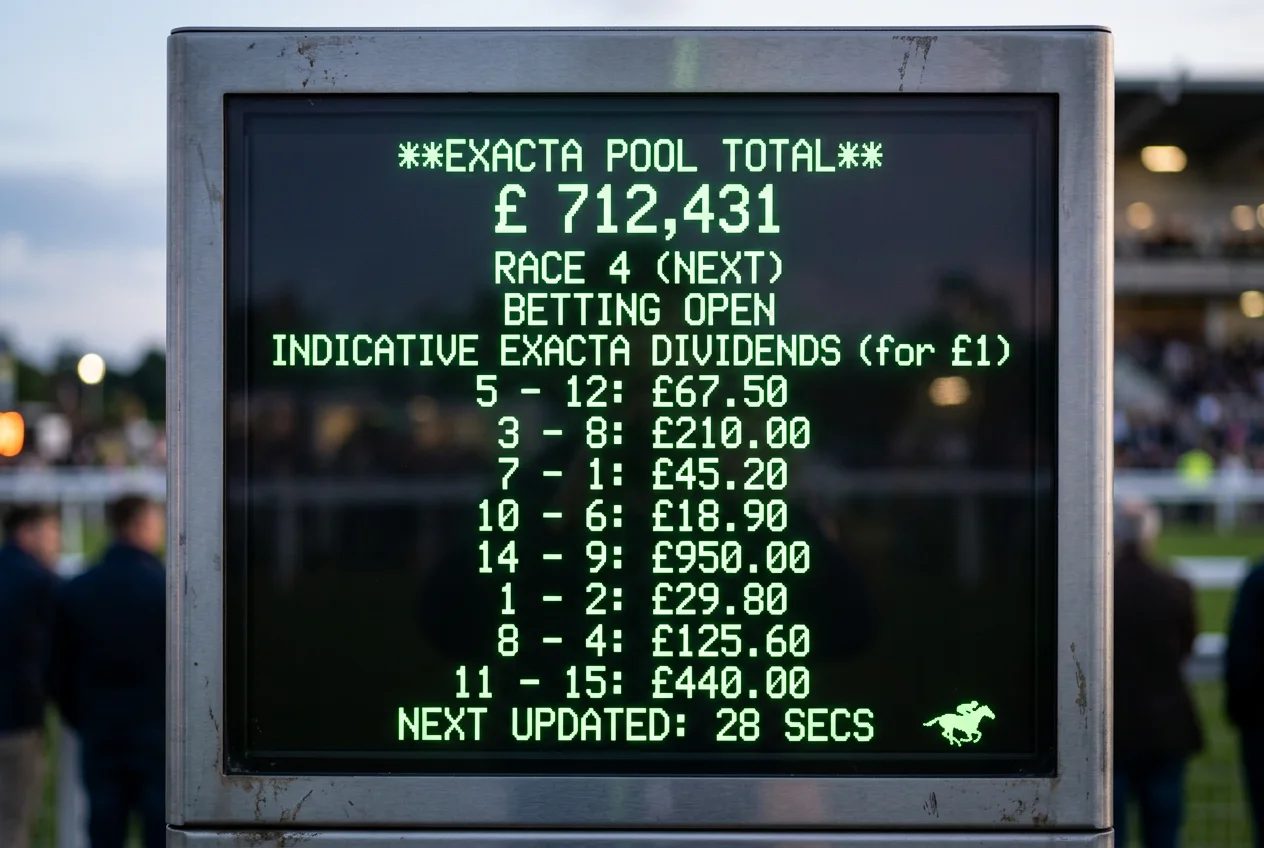
The Tote displays indicative pool totals and approximate dividends on its platform as money enters the pool before the off. These figures update in real time and give you a rough sense of how the pool is shaping up. If the indicative dividend on your preferred combination is 15 pounds and you are placing a four-horse box that costs 12 pounds, you know the expected return barely justifies the outlay. If the indicative figure is 80 pounds, the picture looks very different.
The limitation of indicative dividends is that they can change substantially in the final minutes before the off, when the heaviest betting activity occurs. Late money from professional punters and large staking accounts can shift the pool distribution dramatically. I have seen indicative dividends drop by 40% in the last two minutes of betting as large sums landed on the eventual winning combination. The indicative figure is useful as a directional signal, not as a firm number to build your staking decision around.
For a rougher but more independent estimate, you can use implied probabilities from the win market. If Horse A is 3/1 to win (implied probability roughly 25%) and Horse B is 6/1 (implied probability roughly 14%), the probability of Horse A winning and Horse B finishing second is substantially less than 25% multiplied by 14% – you cannot simply multiply the individual probabilities because the events are not independent. But you can use those win probabilities as a rough guide to how popular the combination is likely to be in the pool. Combinations involving short-priced horses attract more money, producing lower dividends. Combinations involving longer-priced horses attract less money, producing higher dividends.
I use a simple mental model: if the combined win odds of my two selections exceed 15/1, the exacta dividend is likely to be worth pursuing with a box or key. If the combined odds are below 5/1, the dividend is probably modest and a straight exacta at full unit stake is the only format that makes financial sense. Between 5/1 and 15/1, I assess the race individually based on field size, pace dynamics, and pool depth. This is not a scientific formula – it is a heuristic that keeps me from chasing small dividends at disproportionate cost.
What Pushes Dividends Up and What Drags Them Down
A friend once asked me why two races on the same card, with similar pool sizes, produced dividends that differed by a factor of ten. The answer boiled down to three variables that work in combination – and understanding them is the difference between chasing dividends blindly and targeting them with purpose.
Field size is the single strongest predictor. UK flat racing averages 8.90 runners per race across all fixtures, but Premier meetings push that figure to 11.02. Every additional runner multiplies the number of possible first-and-second combinations, which spreads the pool money thinner across outcomes. A 6-runner race has 30 possible exacta combinations. A 14-runner race has 182. If the total pool is similar in both cases, the average dividend in the larger field is roughly six times higher. Larger fields also produce more surprises – the chance that two outsiders fill the first two places increases geometrically as the field expands. When I look at a day’s card and see a 16-runner handicap sitting alongside a 5-runner conditions stakes, I know where the dividend potential lives.
The second factor is market concentration – how heavily the public has backed a single combination. When a dominant favourite lines up against one clear rival, the majority of the pool flows into one or two exacta combinations. If that expected result materialises, hundreds of winning units share the net pool, and the dividend is correspondingly low. When the betting is diffuse – spread across many combinations without a clear favourite pair – any winning result produces a larger dividend because fewer units hold the correct combination. Market concentration is why competitive handicaps reliably outpay Group races with short-priced favourites. Favourites win roughly 30 to 35% of all UK flat races, and odds-on favourites convert at 55 to 60%, but winning the race is only half the exacta puzzle. The favourite finishing first and the second favourite finishing second is the least valuable outcome from a dividend perspective.
Pool depth is the third lever. Britbet’s on-course pool turnover reached 73.6 million pounds in 2024, up 26% since 2018, and racecourse attendance exceeded 5.031 million in 2025. These aggregate figures matter because deeper pools create more stable dividends and reduce the volatility that can make small-pool exactas feel like lottery tickets. On World Pool days, the integration of global liquidity pushes Exacta pools far beyond domestic levels – total World Pool turnover hit the equivalent of roughly 1.2 billion euros in 2025, with foreign racing’s share climbing 20% to approximately 9.3 billion Hong Kong dollars. The practical consequence: on World Pool days, a single bettor’s wager has less influence on the final dividend, which means the payout more accurately reflects the true difficulty of the result rather than the quirks of a thin local pool.
These three factors interact in ways that are not always intuitive. A big field in a weak race at a minor Monday meeting might produce a thin pool despite having 14 runners. The field size creates lots of combinations, but the small pool means each combination attracts very little money – and a surprise result can produce a headline dividend on a total pool of just a few thousand pounds. Alex Frost, the UK Tote Group’s chief executive, has talked about making “world-class pools accessible to everyday punters” – and that accessibility works both ways. Big pools stabilise dividends upward for good results and downward for obvious ones, giving skilled bettors a more reliable canvas to work with.
One factor that bettors overlook is the declining UK horse population, which has been shrinking at roughly 1.5% per year since 2022. Fewer horses mean smaller fields over time, which compresses the number of exacta combinations and, all else being equal, pushes dividends lower. If this trend continues, the golden era of 14-runner handicaps producing four-figure exacta dividends will gradually give way to smaller fields and more predictable outcomes. Exotic bets currently account for 8 to 12% of UK racing turnover – a figure that will only sustain itself if pool operators keep finding ways to generate the deep, liquid pools that make exacta betting worthwhile. Estimate your return with our exacta dividend calculator.
Frequently Asked Questions
How is the Tote Exacta dividend calculated?
The Tote takes the total Exacta pool, deducts 25% (or 19.5% on World Pool races), then divides the remainder by the number of winning unit stakes. The result is declared as the dividend to a one-pound unit. Your actual payout is this dividend multiplied by your unit stake size.
Why do exacta payouts vary so much between races?
Three main factors drive dividend variation: field size (more runners means more combinations and fewer winning units), market concentration (races with dominant favourites produce lower dividends), and pool depth (deeper pools stabilise dividends while shallow pools create volatility). A 14-runner handicap with a surprise result can pay ten times more than a 5-runner Group race won by the favourite.
Does the Tote Exacta pay more than bookmaker forecasts?
In 83% of races, the Tote Exacta pays more than the equivalent Computer Straight Forecast. On World Pool days, the Exacta beats the bookmaker forecast 73% of the time, paying on average 30% more. Across a sample of 3,270 turf flat races, the average Exacta dividend was 102 pounds 44 pence compared to 61 pounds 50 pence for the CSF – a 67% premium.
Can I estimate an exacta payout before placing my bet?
You can build a rough estimate using the pre-race pool size displayed on the Tote interface. Subtract the deduction percentage, then estimate how many units might back your chosen combination based on the runners’ odds. This gives an indicative dividend, though the final figure depends on late betting activity that only concludes when the race starts.
Published by the Horse Racing Exacta bet team.